Image of Houston Control Center
featured

Washington—We Have a Problem!

Vincent F. Cotter, Ed.D.

In 1970, Apollo 13 radioed to mission control the following message:

“Houston, we have a problem!

With lives hanging in the balance, Gene Kranz, NASA Flight Director, rallied his team to solve the problem. Clearly, “Failure was not an option.”2

Almost fifty-five years later, major cities such as Chicago, Philadelphia, Baltimore, the District of Columbia, and New York struggle annually to reach NAEP proficiency levels.3 Years of data document underperformance in the same schools amounting to thousands graduating in the 30th percentile.4

While lives are not immediately in jeopardy, the long-term negative impact of a poor education is well-known. Unemployment,5 incarceration,6 and other issues which are directly correlated to a poor education have plagued communities for years. Despite this crisis, the annual response from Washington is always a nuanced message that with more funding the variables such as poverty and its spinoffs that contribute to poor achievement might be mitigated in time. Underlying the response is a subliminal message that “Failure is Acceptable.”

Accepting failure in education seems outrageous because it erodes the foundation of our democracy. When placed in the context of the current presidential election there is no other way to interpret it. The economy and immigration have dominated the headlines. Even though education plays a key role in each of these issues, it has been ignored. Despite its importance, neither candidate has made it a focal point. If discussed at all, the solutions are narrowed to eliminating the Department of Education or adopting school choice policies. Both ideas jettison systemic solutions which focus on maximizing the potential of ALL children.

How we educate our children that are currently in our schools and those that have arrived “on our doorsteps” will chart our future. Creating opportunities through a rigorous curriculum that places a priority on performance will only solidify our global position in a world that values knowledge, expertise, technology, and creativity. Understanding our philosophical differences through consensus decision-making that does not require approval of an entire plan by the “majority” but rather an agreement on its key elements.

So, let the call go out once again: “Washington, We Have a Problem!” Be bold!

Know that the success of our country depends on an educated and tolerant populace. We need to create a K-12 strategic plan that focuses on skill development. We need an education curriculum that stimulates a renewal of patriotism and a faith that our institutions will provide them with an “equal playing field” based on skill and knowledge. Failure to do so will result in our incremental self-destruction as a country and a people.

                                                            References
  1. Uri, John, “Houston, We’ve Had a Problem,” NASA, April 13, 2020, http://www.nasa.gov>history.
  2. Gene Kranz, Failure is Not an Option, New York City: Berkley Publishing, 2020.
    National Center for Educational Statistics (NCES), 2022 Reading Trial Urban District Snapshot,” 2022, https://nces,ed.gov/nationsreportcard/subject.
    Ibid.
  3. Yifi Qin, “The Relationship between Educational Attainment, Unemployment Rate, and Income Disparity in the United States,” Research Gate, August 17, 2023 (Journal of Education Humanities and Social Science 19:60-64, https//researchgate.net>publication.
  4. Gitnux Report 2024, “Education and Incarceration Statistics: Impact on Prison Reform, July 17, 2024, http://www.gitnux.org

    Author

    Dr. Vincent F. Cotter, Ed.D. is a former Superintendent of Schools, professor, consultant, an American Society for Quality’s Juran Medal recipient for sustained improvement in student achievement, Co-founder of the Exemplary Schools Organization, and author of three Rowman and Littlefield books on school leadership: Performance is Key; Igniting School Performance and Leaning into the Future—Building Beyond the Post-COVID 19 New Normal.
Uncategorized

Education: A Value that Unites Us?

A Feature by Dr. Vincent Cotter on Michael Smerconish’s Smerconish.com

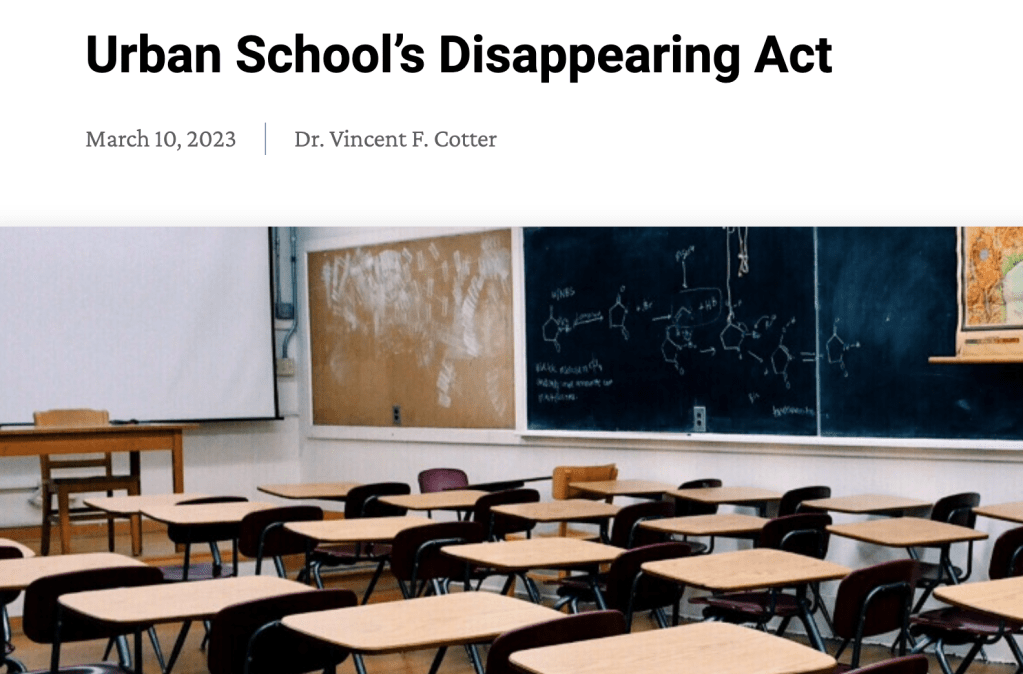
Image of an empty classroom

While it is understandable that schools may want to compare themselves to others with similar demographics and challenges, at what point is it acceptable to be satisfied with mediocrity, let alone failure? Yes, an organization can learn a lot from failure, but in this case, the failures are decades long. Even more tragic is that governmental oversight continues to reinforce these outcomes with a continuous stream of funding without any serious attempts at eliminating the “root cause” of the problem. Unfortunately, parents often realize too late that ineffective educational practices do little to prepare their children for life, and tragically these failing practices restart the cycle of failure over again. Read the full article at smerconish.com

Uncategorized

Education: A Value that Unites Us?

A Feature by Dr. Vincent Cotter on Michael Smerconish’s Smerconish.com

SMERCONISH WEB HEADER

It is somewhat of an oxymoron to suggest that educational institutions have the potential to resolve our fractured political and social issues which have polarized America into distinct ideological camps, particularly when you consider the extent of its self-imposed controversies. Parental rights, curriculum content, gender identification, and school admission practices have many leaders failing to see “the forest for the trees.” Read the full article at smerconish.com

Book Cover Leaning into the Future
Materials, Uncategorized

Leaning Into the Future

Use promo code RLEGEN20 to get a 20% discount!

Leaning into the Future

Building Beyond the Post-COVID-19 New Normal

VINCENT F. COTTER

“Leaning into the Future successful flips the narrative from one of reaction to proactivity. Understanding how to resolve complex issues without internal chaos is an art. We often only get one opportunity to “get it right.” Leaning into the Future provides all leaders with that opportunity.”— Francis Barnes, former PA Secretary of Education, former Superintendent of Schools

“The concept of “leaning forward” is an established action in a number of fields: athletics, leadership, military, etc. Dr. Cotter takes the notion of “leaning forward” and focuses “laser like” upon current educational issues facing our community schools. The concepts and processes presented serve as a gateway for the coordinated efforts for all who have a vested interest in enhancing school and school district achievement.”— Harry J. Gaffney, former Regional Superintendent, School District of Philadelphia, Adjunct Professor, Saint Joseph’s University

“Now is the time to respond to the learning crisis proactively and with purpose. Cotter’s book provides a strategic guide for educational leaders to “lean forward” and address the current learning crisis in a transformational manner. Cotter outlines the need for “synertegic” leaders to commit, respond, and reinvent our schools utilizing a continuous improvement model. This book is essential reading for educators preparing to move their schools and districts “Above and Beyond.”— Michael McKenna, Director of Elementary Education, North Penn School District


In returning to the classroom, schools are at a crossroads and uniquely positioned to recreate and reinvent themselves. The current issues of equity, social-emotional sensitivity, curriculum reform, civic involvement, public health policy and environmental infrastructure are opportunities to build more responsive schools with students better prepared for the future. 


Vincent F. Cotter, as superintendent of schools, was the primary innovator of a unique school improvement program that dramatically improved student achievement, and for his efforts, he was awarded the prestigious American Society for Quality’s International Juran Medal in the field of education for sustained systemic improvement.

January 2022 • 140 pages
Hardback 978-1-4758-6403-8 •Paperback 978-1-4758-6404-5 • eBook 978-1-4758-6405-2
Hardback $70.00 • Paperback $30.00 • eBook $28.50
Please visit www.rowman.com or call (800) 462-6420 to place an order.